Route 17
Children of the CornRoute 17 is the approach to Gatlin and the physical thread connecting its town streets, church, and surrounding cornfields. As Burt and Vicky travel it, ordinary road signs and roadside businesses give way to unsettling religious messages, outdated prices, and an apparent absence of other travelers; the road marks their gradual passage into the town’s closed and dangerous world.
The approach to Gatlin
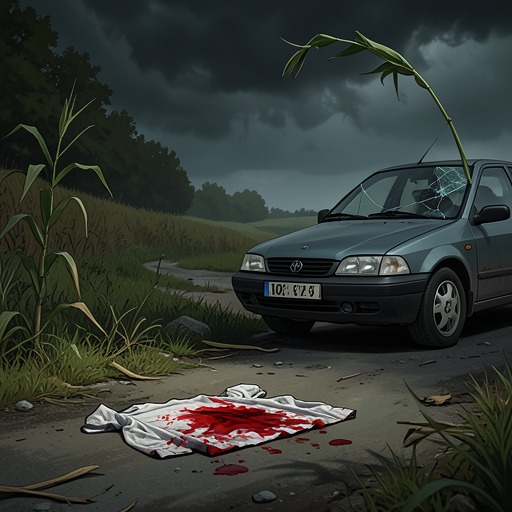
Burt identifies the road by name while asking Vicky whether they have passed anything since leaving the turnpike. She recalls a car and a tractor at an intersection, but thinks they have seen nothing since joining Route 17. The road’s sparse traffic soon becomes more consequential: a boy runs out of the corn and into the path of their T-Bird. Burt brakes, and the collision changes the journey from an uneasy drive into a crisis that binds their arrival to the town and its children.
The road also carries a religious broadcast into the car. As the station grows clearer, a red radio tower appears above the corn at the horizon. The preacher speaks about atonement and salvation, making the countryside’s religious language audible before Burt and Vicky reach Gatlin itself. The road is therefore not merely a route through farmland; it is the channel through which the community’s presence first becomes difficult to ignore.
Signs, objects, and the town boundary
A sign announces Gatlin as five miles away and asks drivers to protect its children. The sign, put up by the Elks and marked by .22 bullet holes, gives a conventional civic warning an ominous edge after the boy’s sudden appearance from the corn. The juxtaposition makes the road’s public message feel less like reassurance than a forewarning.
The journey also reveals the material forms of Gatlin’s faith. While Vicky searches a suitcase, she and Burt examine a small crucifix fashioned from dried corn husk, cornsilk, and a cob whose remaining kernels form a figure. The object makes the local religion tangible before the couple reaches the town center. Farther along, a billboard declares that only Jesus saves, extending religious messages from the radio and roadside signs into the landscape itself.
Entering Gatlin
After the fields open out, the road brings Burt and Vicky past farmhouses, barns, a café, and a Conoco gas island. Burt decides to continue toward the center of town rather than stop at the café; only after passing it does he register that its lot is nearly empty. The surrounding landscape is agricultural and inhabited, but its sparse signs of activity make the approach feel increasingly isolated.
A rise reveals Gatlin, described as three blocks of town. Route 17 passes diseased elms, the Gatlin Lumberyard, and a 76 gas station before crossing Elm Street and Birch Street toward the square. The gas station advertises regular fuel at 35.9 and high-test at 38.9, prices Vicky recognizes as at least four years out of date. She points out that there is not a single car in town. The combination of obsolete prices, empty streets, and quiet storefronts turns the road’s apparent arrival at a functioning town into evidence that something is wrong.
From public road to religious territory
Near the town center, Burt notices a church sermon board announcing the power and grace of He Who Walks Behind the Rows, dated the previous Sunday. Inside the church, he finds a book whose cover invokes the cutting down of the iniquitous so that the ground may become fertile. These messages connect Gatlin’s religious authority directly to the agricultural landscape through which Route 17 has carried the couple.
The road’s movement from highway to town streets gives way, ultimately, to movement into the corn. In the account of Gatlin’s practices, the Age of Favor is lowered from nineteen plantings and harvests to eighteen, and those above the newly stated limit walk into the fields to reach a clearing. The girls later make corn-cob crucifixes to ward off further evil. These details sharpen the contrast between the open, traversable road and the fields that surround it: Route 17 brings outsiders to Gatlin’s boundary, but the cornfield holds the town’s ritual center and the consequences of its faith.